
ST. PAUL, MN, USA, June 16, 2026 (GLOBE NEWSWIRE) — Last weekend, under the floodlights and patriotic pageantry of the White House South Lawn, UFC Freedom 250 transformed America’s most famous address into a modern coliseum. There was a rowdy Octagon beneath a towering canopy nicknamed The Claw, military flyovers, celebrity spectators, Ultimate Fighting Championship President and CEO Dana White on the balcony, U.S. President Donald J. Trump celebrating his eightieth birthday in the front row, and seven fights that turned the nation’s 250th-anniversary festivities into one of the most headline-grabbing combat-sports spectacles in memory.
The main event at “The People’s House” had everything prizefighting has always loved: an undefeated champion, an underdog with thunder in his hands, personal bad blood, national flags, genuine gladiators with catchy nicknames, eye-popping spectacle, high-stakes danger, and the powerful, inchoate pull of destiny.
To the modern eye, it felt unprecedented. To readers of The St. Paul Phantom: The Gibbons Brothers’ Fight for Glory, Volume I, this fall’s first of three installments in the critically-acclaimed, definitive historical biography of Irish-Americans, Mike and Tommy Gibbons, it felt like history wearing new gloves.
A hundred years ago, Mike “The St. Paul Phantom” Gibbons and his younger brother Tommy “The Happy Warrior” Gibbons stood at the center of America’s original fight-industrial complex, where boxing distilled the early twentieth century’s chaos into two corners, ropes, rules, and consequence. Mike and Tommy fought their way into history via smoky clubs, armories, ballparks, theaters, and the illustrious “temple of fistiana,” Madison Square Garden, promoted by enigmatic powerhouse Tex Rickard and his “million-dollar gates.” They understood the prize ring was one of the only places on earth where an immigrant son could aspire to—and sometimes claim—the fabled American Dream, even in an era when professional boxing remained outlawed, restricted, or morally suspect across much of the United States.
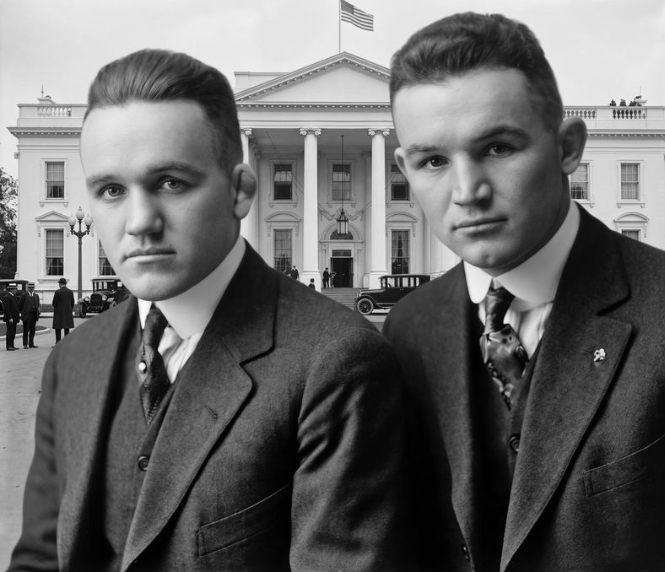
Mike “The St. Paul Phantom” Gibbons and his brother Tommy “The Happy Warrior” Gibbons. A century before UFC Freedom 250, the brothers stood at the center of America’s original fight game.
In other words, the Gibbons brothers, legendary Hall-of-Famers, long-known as “the shining knights of the ring,” were also, in contemporary parlance, among the OGs—or “original gangstas”—of the sport.
The St. Paul Phantom resurrects the nearly forgotten world of turn-of-the-century America with the sweep of historical narrative nonfiction: the 1910 Halley’s Comet vow; the rough Frogtown boyhood; the death-haunted lessons of early prizefighting; Mike’s rise from St. Paul to Madison Square Garden; the shadow of Jack Johnson, Joe Gans, Sam Langford and the color line; the Great War years at Camp Dodge, where Mike and Tommy trained doughboys for trench warfare; the Spanish Flu; the denied military commissions; and the final, bruising question of what a fighter owes his family, his country, and his name.
“From the beginning of this nation’s history, combat sports are where America has staged its arguments about masculinity, class, race, immigration, celebrity, patriotism, money, honor, and violence. A century ago, just as now, we were electrified by the operatic drama, larger-than-life promotional machinery, and raw pursuit of legacy and fortune,” says St. Paul Phantom author Dr. Gerard Gibbons, grandson of Tommy Gibbons and great-nephew of Mike Gibbons. “The UFC cage is new, but the hunger and yearning—the fundamental quest and fight for glory—is old as time.”
Long before UFC champions entered the cage beneath the South Lawn lights, Call of the Wild author Jack London wrote that “fighting is no superficial thing, a fad of a moment or a generation… [It is] woven into the fibers of our being.” As evidence, “strenuous life” proponent, Gibbons brothers fan, and twenty-sixth President Theodore Roosevelt transformed his White House into a veritable shrine to physical combat, sparring frequently in the West Wing with soldiers, athletes, and fighting men of his era.
“President Roosevelt loved the ring because he believed that struggle built character,” says award-winning author and historian Gibbons. “He saw fighting, disciplined and rule-bound, as a moral education in courage, endurance, respect and humility. This speaks great truth about the men Mike and Tommy Gibbons were in their time, and of many contemporary boxers, trainers, and mixed martial artists too.”
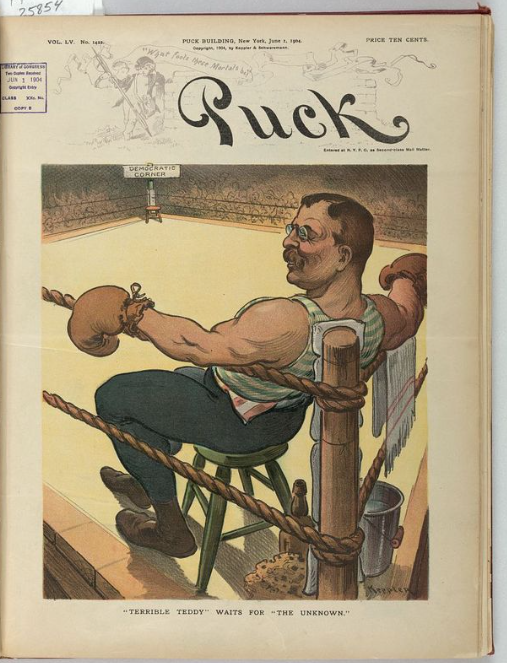
Puck magazine, June 1, 1904: “Terrible Teddy” Waits for “The Unknown.” President Theodore Roosevelt, a devoted boxing enthusiast, made his White House a shrine to the ring. (Library of Congress)
Fighting for family, faith, freedom, and fortune, Mike Gibbons, the “Phantom,” was a scientific conundrum who made violence look like geometry—slipping punches by inches, answering with clean precision, and making reporters reach for language usually reserved for magicians, chess masters, and ghosts. Tommy Gibbons, bigger, warmer, and more openly heroic, carried the same St. Paul schooling into the heavyweight ranks, where courage, durability, and decency became part of his public identity. Between them, the Gibbons brothers fought their way through a rogue’s gallery of brawlers, sluggers, champions, and immortals, including Harry Greb, Jack Dempsey, and Gene Tunney.
If the Freedom 250 Octagon was flashier and its fighter personalities more flamboyant, several of the combatants nevertheless echoed the Gibbons brothers’ century-old “sweet science” ringwork at the White House. Light-footed and deeply composed, heavyweight Ciryl Gane snapped and shuffled classic “Phantom” strategies into battle, resisting crude slugging in favor of remaining elusive, measured, surgical, and calculatedly dangerous in his upset of Alex Pereira. In his two-round dismantling of Aiemann Zahabi, neon-mopped bantamweight Sean O’Malley deployed several trademark “Phantom” moves, serving up a cool carousel of range, timing, long jabs, and controlled striking. And in a shocking upset, Justin Gaethje, horror-bloodied the face of Ilia Topuria, to claim the world lightweight title, demonstrating what the Gibbons brothers often said, “No one plays boxing!”
“The Octagon at the White House proved that the hunger for combat narrative is an indelible part of the American psyche,” says author Gibbons. “For fans captivated by the strategic chess match and raw human drama of the UFC, The St. Paul Phantom—and the two additional, forthcoming books in the Fight for Glory franchise—captures the genesis of that obsession, the crucial origin story of how a man with courage, discipline, and faith can change his stars.”
The St. Paul Phantom: The Gibbons Brothers’ Fight for Glory, Volume I publishes September 15, 2026, from Fight for Glory Press.
An American Epic for the Semiquincentennial
Arriving during America 250, the nation’s Semiquincentennial, The St. Paul Phantom draws on deep family archives, rare photographs, and letters untouched for decades. Early readers are comparing this historical biography to Seabiscuit, Cinderella Man, and The Boys in the Boat—stories where sports become the lens through which a nation sees itself.
Through the lens of the Gibbons brothers, readers encounter an era of illegal prizefighting, vaudeville celebrity, the 1918 influenza pandemic, and an unforgettable cast of characters including: Jack Johnson, Harry Greb, Joe Gans, F. Scott Fitzgerald, Nellie Bly, Theodore Roosevelt, and Tex Rickard.
The work has already garnered recognition from the International Boxing Research Organization (IBRO) and carries endorsements from Academy Award-nominated filmmakers Paul Tamasy (The Fighter) and Brian Frankish (Field of Dreams), Grammy-nominated musician and boxing historian Frank Stallone, as well as Kirkus Reviews, IndieReader, and Publisher’s Weekly / Booklife.
Availability & Community Pre-Order
The St. Paul Phantom: The Gibbons Brothers’ Fight for Glory, Volume I officially publishes September 15, 2026, in hardcover, paperback, ebook, and audiobook formats. To pre-order, please visit: www.Books2Read.com/TheStPaulPhantom. Ahead of the launch, boxing fans and history buffs can join Ringside America, the book’s exclusive online reader community at the Fight for Glory website. Members receive Inside the Archive access—featuring digitized images and letters from the family collection—along with preview chapters, audiobook samples, and a locked-in, members-only pre-order price.
About the Author
Dr. Gerard Gibbons is an award-winning filmmaker, historian and direct descendant of the Gibbons boxing family. His Fight for Glory trilogy restores the epic true story of his family’s place in American sports, immigrant culture, and the pursuit of the American Dream, spanning the years 1884-1983.
About Fifth Story Press and Content Syndicate
Fifth Story Press is a boutique publisher and author services company. Content Syndicate provides media distribution and public relations across a network of more than 1,200 endpoints. The St. Paul Phantom campaign is produced for Fight for Glory, LLC.

Angela Robinson
Fifth Story Press
angela(at)blockchainiwre.io


