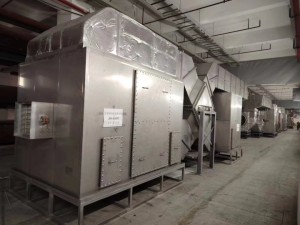

HANGZHOU, ZHEJIANG, CHINA, November 27, 2026 /EINPresswire.com/ — For industrial procurement teams and HVAC engineers, evaluating equipment manufacturing capability requires looking beyond generic facility photographs and square-footage claims to examine how physical production assets safeguard equipment performance. At Dryair, an Advanced Rotary Desiccant Dehumidifier Factory integrates automated sheet-metal fabrication, insulated panel manufacturing, specialized rotor handling, precision assembly, and rigorous pre-delivery testing. These manufacturing disciplines directly protect casing airtightness, thermal insulation, and rotor configuration integrity, ensuring that each manufactured rotary desiccant dehumidifier performs reliably under demanding industrial conditions.
Casing Construction Protects the Designed Air Path
In industrial dehumidifier manufacturing, casing airtightness is defined as the structural ability of the cabinet to prevent ambient air infiltration and internal air bypass between process and reactivation sectors under design static pressures. The structural casing of a rotary desiccant dehumidifier does far more than enclose internal components; it forms the primary boundary separating conditioned process air from ambient surroundings and isolates the dry process stream from the hot, humid reactivation sector. In low-dew-point applications, even minor casing leakage or thermal bridging degrades supply-air dew points and causes surface condensation.
Dryair’s ZCB Series combined desiccant dehumidifiers utilize double-wall insulated casing construction engineered specifically for airtightness and thermal performance. Depending on project specifications, panel exterior and interior surfaces are fabricated from galvanized steel, aluminum alloy, or stainless steel. Furthermore, the broader ZC product platform incorporates anti-cold-bridge structural framing with high-density polyurethane (PU) sandwich insulation panels. This construction minimizes conductive heat gain, prevents condensation on outer cabinet walls, and eliminates air leakage across panel joints, ensuring that the moisture depression achieved by the desiccant rotor is preserved through to the duct discharge.
Rotor Configuration Must Match the Required Moisture Duty
The desiccant rotor represents the thermodynamic heart of the dehumidifier. Sizing and configuring the rotor must reflect the specific entering air humidity, target leaving moisture content, process airflow, and available regeneration utilities.
Within Dryair’s ZCH Series low-dew-point platform, units support both silica-gel and molecular-sieve rotor configurations. Manufacturing an effective rotary desiccant dehumidifier requires precision engineering of the rotor perimeter seals, radial partition seals, and drive mechanism. Factory review procedures must verify rotor dimensions, face velocity limits, drive belt alignment, and seal contact pressure. Properly aligned silicone or PTFE seals ensure that air cannot bypass the desiccant matrix, while maintaining complete physical separation between the counter-flowing process and reactivation air streams.
Sheet-Metal and Panel Production Affect Equipment Repeatability
Equipment durability and dimensional consistency originate in the primary fabrication stages. Dryair’s manufacturing facility incorporates advanced metalworking infrastructure, including high-precision laser cutting machines, computer numerical control (CNC) press brakes, and an automated high-pressure foam panel production line.
CNC laser cutting and automated bending ensure that sheet-metal components, structural frames, and panel skins are manufactured with tight tolerances. This precision guarantees that cabinet panels fit together with uniform compression along perimeter gaskets, preventing the air leakage that frequently plagues manually fabricated enclosures. For procurement auditors, inspecting these automated fabrication lines provides tangible evidence that equipment housings achieve repeatable structural rigidity and tight sealing across high-volume production batches.
Rotor and Component Handling Belong in the Factory Review
Because desiccant rotors, centrifugal fans, cooling coils, and sensitive instrumentation can be damaged by improper storage or handling prior to assembly, factory storage disciplines represent a vital quality checkpoint.
Dryair’s production facility maintains dedicated, environmentally controlled warehouse areas for desiccant rotors, electrical components, and precision mechanical drives. Desiccant rotors are stored in sealed packaging to prevent premature moisture adsorption or chemical contamination from factory atmospheres before installation into the dehumidifier chassis. Quality assurance protocols track component serial numbers from receiving through assembly, ensuring complete traceability for every critical subsystem within the completed unit.
Testing Should Be Tied to Project Acceptance Requirements
Catalog data and design simulations establish theoretical performance, but factory acceptance testing (FAT) validates that the assembled dehumidifier operates correctly before leaving the factory floor. Dryair’s facility incorporates dedicated testing bays equipped with calibrated instrumentation and utility connections.
Pre-delivery testing protocols should verify:
Full-load electrical operation, motor phase balancing, and control panel wiring integrity.
Fan rotational speed, vibration analysis, and external static pressure capability.
Desiccant rotor drive motor operation, rotation speed, and drive belt tension.
Reactivation heater circuit staging, temperature limit cutouts, and safety interlocks.
PLC program execution, touchscreen display navigation, and sensor input calibration.
Conducting these comprehensive checks in the factory reduces commissioning delays and troubleshooting time during on-site installation.
Dehumidifier Patents Add Engineering Context to Factory Capability
Verifiable intellectual property provides objective context regarding an equipment manufacturer’s technological depth. Dryair holds a portfolio of specialized dehumidification patents that directly address casing and rotor manufacturing challenges.
Dryair previously obtained utility model patent 201120480981.6 for an engineered desiccant-dehumidifier casing design covering panel sealing and thermal barrier features. The company also holds invention patent 200910154107.0 for a manufacturing method for a lithium-chloride and silica-gel composite desiccant rotor. These patents reflect long-term engineering work on cabinet airtightness, thermal bridging, and desiccant media retention.
This manufacturing breadth is substantiated by major industrial installations. For example, in a historical 2018 supply contract for CATL’s Qinghai battery manufacturing facility, Dryair fabricated and delivered 14 large-scale ZCB and ZCH units across multiple model sizes, demonstrating the factory’s capacity to execute complex, high-volume production contracts under rigorous quality standards.
Use the Factory Review to Close Engineering Risks Before Production
A thorough factory audit should serve as an engineering risk-reduction exercise before commercial fabrication commences. Technical buyers and HVAC consultants should focus their review on:
Casing double-wall construction, insulation core density, and anti-cold-bridge framing details.
Panel skin materials (galvanized, aluminum, or stainless steel) matched to environmental conditions.
Rotor media selection (silica gel or molecular sieve) and seal design.
Automated sheet-metal cutting and bending tolerances ensuring repeatable cabinet tightness.
Dedicated rotor storage protocols protecting media from pre-installation contamination.
Comprehensive factory acceptance testing scope and documentation.
Project drawing submittals detailing dimensional clearances and connection interfaces.
By conducting a structured factory evaluation around these criteria, engineering teams can verify that Dryair’s manufacturing capabilities align with the strict reliability requirements of their facility. To schedule a technical consultation or explore equipment options, visit the Dryair official website.
Dryair
Dryair
Legal Disclaimer:
EIN Presswire provides this news content “as is” without warranty of any kind. We do not accept any responsibility or liability
for the accuracy, content, images, videos, licenses, completeness, legality, or reliability of the information contained in this
article. If you have any complaints or copyright issues related to this article, kindly contact the author above.

Media gallery