The Business Research Company’s Petrochemical Feedstock Market Global Market Report 2026 – Market Size, Trends, And Forecast 2026-2035
LONDON, GREATER LONDON, UNITED KINGDOM, November 27, 2026 /EINPresswire.com/ — The petrochemical feedstock market has experienced remarkable growth in recent years, driven by increasing industrial production and rising demand across various sectors. Understanding the market’s expansion, key contributors, segmentation, and emerging trends provides valuable insight into its future trajectory and opportunities.
Steady Growth in Petrochemical Feedstock Market Size
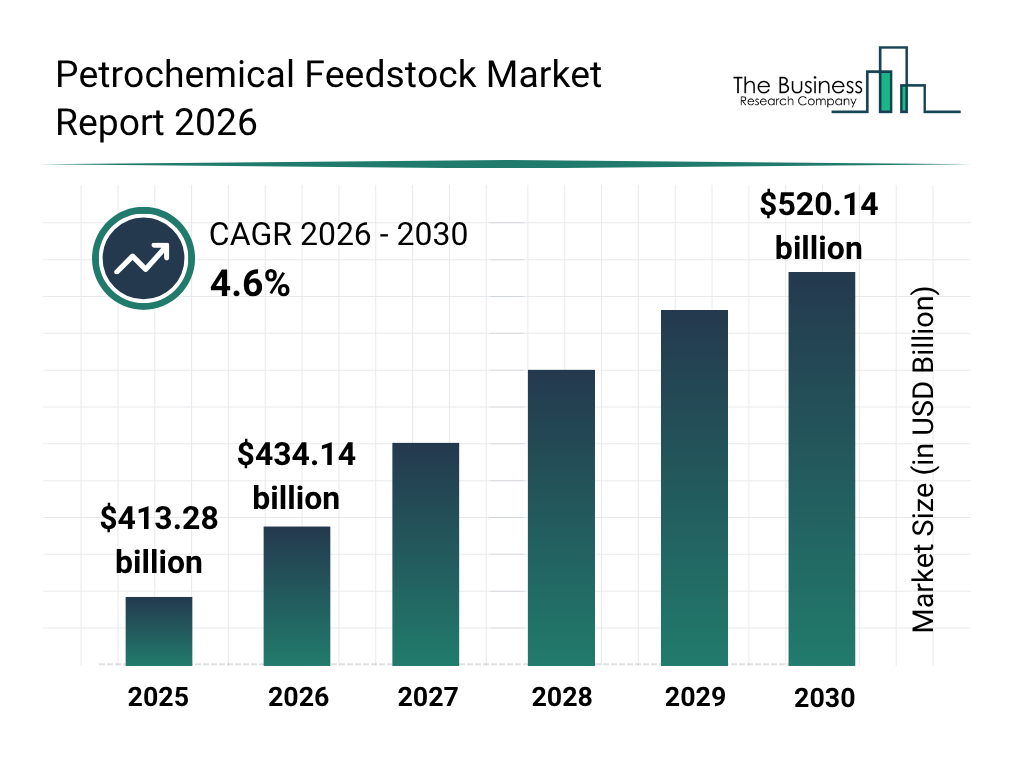
The market for petrochemical feedstock has expanded significantly, with projections showing an increase from $413.28 billion in 2025 to $434.14 billion in 2026, reflecting a compound annual growth rate (CAGR) of 5.0%. This upward trend over the past few years is largely fueled by increased petrochemical production capacity, stronger demand for fundamental chemicals, growing consumption of plastic products, expansion in packaging manufacturing, and a rise in automotive manufacturing activities.
Download a free sample of the petrochemical feedstock market report:
https://www.thebusinessresearchcompany.com/sample_request?id=57177228&type=smp&name=Petrochemical%20Feedstock%20Market%20Report%202026&utm_source=EINPresswire&utm_medium=Paid&utm_campaign=Nov_PR
Forecasted Expansion of the Petrochemical Feedstock Market Through 2030
Looking ahead, the petrochemical feedstock market is poised for continued growth, anticipated to reach $520.14 billion by 2030 at a CAGR of 4.6%. This expected development is supported by higher demand for natural gas-based feedstocks, broader adoption of renewable feedstocks, expanding needs for olefins and aromatics, and increasing petrochemical production in emerging markets. Additionally, industries such as electronics and healthcare are driving further demand. Key trends shaping this growth include enhanced feedstock flexibility, increased use of bio-based and recycled materials, and a rising emphasis on natural gas and renewable feedstocks.
Automotive Industry as a Major Growth Driver in the Petrochemical Feedstock Market
The automotive sector plays a crucial role in propelling the petrochemical feedstock market forward. This industry, which encompasses the design, manufacture, assembly, and sales of motor vehicles and their components, is experiencing growth due to rising consumer demand for both passenger and commercial vehicles. This surge is supported by growing disposable incomes and improving living standards. As vehicles require plastics, synthetic rubber, resins, adhesives, and coatings—all derived from petrochemical feedstocks—the expansion of automotive production significantly boosts feedstock demand. For instance, in March 2026, the International Organization of Motor Vehicle Manufacturers (OICA) reported that vehicle production in France reached 1.46 million units, an 8% rise compared to 2025, illustrating this positive impact.
View the full petrochemical feedstock market report:
https://www.thebusinessresearchcompany.com/report/petrochemical-feedstock-market-report?utm_source=EINPresswire&utm_medium=Paid&utm_campaign=Nov_PR
Segment Breakdown Highlighting the Structure of the Petrochemical Feedstock Market
This report segments the petrochemical feedstock market into several key categories:
– Feedstock Type: Including Naphtha, Ethane, Propane, Butane, Liquefied Petroleum Gas, Natural Gas, Natural Gas Liquids, Condensates, Bio-Based Feedstocks, and Recycled Feedstocks.
– Source: Categorized as Crude Oil-Based, Natural Gas-Based, and Renewable Feedstocks.
– Process Technology: Covering Steam Cracking, Catalytic Cracking, Catalytic Reforming, Methanol-To-Olefins, Propane Dehydrogenation, and other technologies.
– Application: Including Olefins, Aromatics, Methanol, and other uses.
– End Use Industry: Spanning sectors such as Packaging, Automotive, Construction, Electronics, Healthcare, Textiles, Agriculture, Consumer Goods, Industrial Manufacturing, and others.
The report also delves into subsegments within feedstock types, such as light, full range, and heavy naphtha; conventional and shale-derived ethane; refinery-derived and renewable propane; various forms of butane; different grades of liquefied petroleum gas; associated and non-associated natural gas varieties; as well as bio-based and recycled feedstocks including ethanol, naphtha, propane, butane, plastic feedstocks, waste oils, biomass, and carbon sources.
Technological Innovations Shaping the Petrochemical Feedstock Market
Leading companies in this sector are adopting advanced production technologies to enhance efficiency and reduce costs. One notable innovation is refinery ethane integration, a process where ethane is recovered from refinery off-gases and fed directly into ethylene crackers as a high-value feedstock, replacing its prior use as refinery fuel. This approach improves ethylene yields while cutting transportation and storage expenses through integrated operations. For example, in October 2025, Bright LyondellBasell Petrochemical Co., Limited (BLYB) in China implemented refinery ethane usage in its ethylene cracker, producing approximately 330,000 tons annually and transporting the feedstock via a dedicated pipeline from a nearby refinery, marking a significant operational advancement.
Regional Demand and Market Growth Patterns in Petrochemical Feedstocks
In 2025, North America held the largest share of the petrochemical feedstock market. However, Asia-Pacific is set to become the fastest-growing region during the forecast period. The analysis covers the main geographic regions, including Asia-Pacific, South East Asia, Western Europe, Eastern Europe, North America, South America, the Middle East, and Africa, providing a thorough overview of global market trends.
Key Players Leading the Petrochemical Feedstock Market Globally
The competitive landscape in the petrochemical feedstock market includes several major companies such as Saudi Arabian Oil Company, Exxon Mobil Corporation, China Petroleum & Chemical Corporation, TotalEnergies SE, Shell plc, China National Petroleum Corporation, BP p.l.c., BASF SE, Reliance Industries Limited, Saudi Basic Industries Corporation, Dow Inc., INEOS Group Holdings S.A., LyondellBasell Industries N.V., China National Offshore Oil Corporation, Formosa Plastics Corporation, Equinor ASA, Indian Oil Corporation Limited, Chevron Phillips Chemical Company LLC, Bharat Petroleum Corporation Limited, Oil and Natural Gas Corporation Limited, Westlake Corporation, and Haldia Petrochemicals Limited. These firms are instrumental in shaping the market’s development through investments, technological advancements, and strategic initiatives.
New strategic additions in our 2026 market reports include market attractiveness scoring and analysis, total addressable market (TAM) analysis, company scoring matrix graphics and tables, Excel-based forecasting dashboards, market hotspots infographics, key technologies and future trend analysis, along with updated graphics and tables.
Speak With Our Expert:
Saumya Sahay
Americas +1 310-496-7795
Asia +44 7882 955267 & +91 8897263534
Europe +44 7882 955267
Email: marketing@tbrc.info
The Business Research Company – www.thebusinessresearchcompany.com
Follow Us On:
• LinkedIn: https://in.linkedin.com/company/the-business-research-company“
Oliver Guirdham
The Business Research Company
+44 7882 955267
info@tbrc.info
Visit us on social media:
LinkedIn
Facebook
X
Legal Disclaimer:
EIN Presswire provides this news content “as is” without warranty of any kind. We do not accept any responsibility or liability
for the accuracy, content, images, videos, licenses, completeness, legality, or reliability of the information contained in this
article. If you have any complaints or copyright issues related to this article, kindly contact the author above.

Media gallery