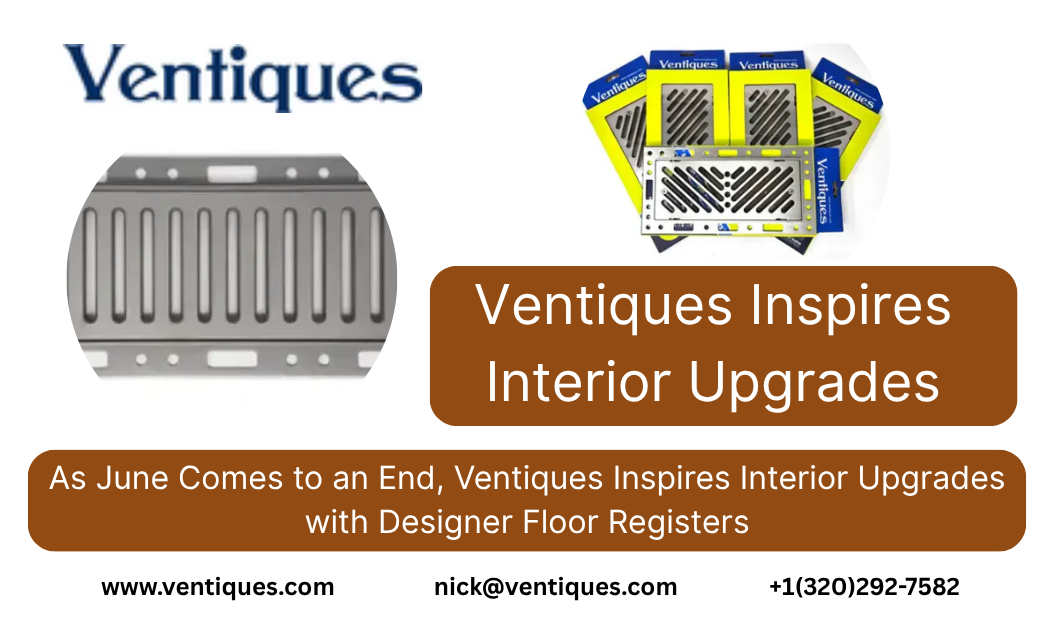
As June Comes to an End, Ventiques Inspires Interior Upgrades with Designer Floor Registers
MINNESOTA, MN, UNITED STATES, June 24, 2026 /EINPresswire.com/ — As June Comes to an End, Ventiques Inspires Interior Upgrades with Designer Floor Registers:
June has a way of making homeowners suddenly, uncomfortably aware of every corner of their house. The weather turns, people start making plans — Father’s Day dinners, graduation parties, the neighbor’s kid’s backyard wedding reception that somehow ends up at your place — and a quiet panic sets in about whether the house is actually ready to be seen. Not just cleaned.
It’s a specific feeling. Most of the year, the scratched threshold strip in the hallway doesn’t register. The outlet cover in the dining room that’s been painted over twice goes unnoticed. And the floor registers — those metal grilles sitting over the HVAC duct openings in nearly every room — get walked over constantly and thought about almost never. Until someone is coming over, Then they’re impossible to ignore.
Ventiques has spent years working in exactly the space most homeowners forget exists. To mark the start of the season, the premium vent brand is highlighting a collection of stylish floor registers designed to complement modern interiors. The catalog covers a comprehensive range floor registers across a wide range of materials, finishes, and design approaches — from cast iron reproductions that belong in a Victorian row house to slim linear slot registers that suit a minimalist modern interior with floor-to-ceiling glazing. June is as a good time as any to actually understand what’s available, because the options are considerably more interesting than whatever is sitting in the floor right now.
Why a Floor Register Matters More Than Its Size Suggests:
Here is something that doesn’t get said often enough: a floor register carries more visual weight than almost any other single hardware element in a room, purely because of where it sits. The floor is the largest continuous horizontal surface in a space. When a register interrupts that surface with a material or finish that doesn’t belong there — a white plastic louver in the middle of warm walnut hardwood, say — the eye catches it immediately, even when the brain doesn’t immediately identify what feels off.
A floor register is no longer seen only as a functional part of an HVAC system. Many modern interiors now treat registers as part of the overall design language of a room. The shape, finish, material, and pattern of a register can either blend quietly into the floor or add a decorative touch that complements the rest of the space. As interior design continues to move toward a more refined and coordinated look, decorative floor registers have become an important finishing element.
The Role of Decorative Floor Registers in Interior Design:
Interior design now places more emphasis on complete visual harmony. Every visible detail matters, including trim, hardware, lighting, and ventilation components. Floor registers fall into that category as well. Because they sit in a prominent position on the floor, they are always part of the room’s visual field.
Older floor registers often had a simple, basic appearance. Their only job was to move air. Modern decorative registers serve the same function but with a much stronger focus on appearance. Better materials, cleaner lines, and more detailed patterns allow registers to contribute to the look of a room instead of interrupting it.
Decorative floor registers can help create a more finished appearance, improve the look of hardwood flooring, add architectural interest, and support a consistent design theme throughout the home. A well-chosen register can make a room feel more polished without drawing too much attention.
Different Types of Floor Registers Cast Iron Registers:
The cast iron floor register predates modern HVAC by a considerable margin. Before forced-air systems with ductwork, buildings were heated by gravity — a furnace in the basement, large floor openings, heat rising naturally to the rooms above. Cast iron covered those openings because it could handle high temperatures, accepted detailed mold work cleanly, and didn’t corrode. The practical constraints of the material produced, as a byproduct, some genuinely beautiful objects.
Wood Registers: The Art of Matching the Floor:
Wood floor registers work on an almost opposite principle from cast iron. Rather than announcing themselves through contrast and surface detail, a well-chosen wood register tries to disappear. The goal — and a quality wood register comes genuinely close to achieving it — is a register that looks like the floor continued right over the duct opening.
Oak covers the majority of wood register orders simply because oak floors are everywhere. But the catalog of available species goes considerably further: hard maple for pale, tight-grained floors; black walnut for darker floors with dramatic natural figure; cherry for warmer reddish-brown tones; hickory for heavily grained, variegated floors; ash for pale open-grain applications. The stain and finish sheen have to align with the existing floor, ideally confirmed with a sample under the actual room lighting before a full order goes in.
Flush-mount wood registers are worth understanding separately from standard drop-in designs. A standard register has a raised border lip that sits proud of the floor surface. A flush-mount installation drops level with the finished floor plane — no raised edge, no lip, no shadow line at the perimeter. The floor reads as continuous. For formal rooms or spaces where the floor material is itself a design statement, the flush-mount approach is the more resolved solution.
Metal Vents: From Stamped Steel to Brushed Brass and Beyond:
Stamped steel dominates floor register sales by volume. It’s cheap, available everywhere, and comes in the most common sizes. What fills most of that market — white or beige louvers, minimal detail, nothing to look at — exists because it gets the hole covered at the lowest possible cost. That’s fine if finish and appearance don’t matter. For anyone who has invested in a well-designed interior, it’s a compromise that shows.
Within metal construction broadly, the design and finish range has expanded substantially.
The demand was driven largely by the coordinated hardware finish trend that took hold in kitchen and bath renovations — once homeowners started specifying brushed brass or matte black for faucets, towel bars, cabinet pulls, and light fixtures, a white floor register in the same room became an obvious problem. Manufacturers caught up, and the current market for metal floor registers in decorator finishes is much more developed than it was ten years ago.
Brushed nickel and stainless steel are the workhorses for bath and kitchen applications. Stainless handles moisture and cleaning chemicals without issue, and a brushed surface texture hides light scratches far better than polished alternatives. For kitchens in particular, stainless registers make maintenance simple — they wipe clean, don’t corrode, and coordinate with stainless appliances without requiring much thought. Many designer-grade vent solutions are made from stainless steel.
Antique brass and brushed brass remain among the most requested finishes in residential design. The warm hardware trend arrived around 2018 and has proven more durable than many expected — new construction and renovations continue to specify brass hardware throughout, and a brass floor register fits naturally into any space already committed to warm-toned metal.
Oil-rubbed bronze suits rooms with dark wood furniture, leather upholstery, and a generally warm, layered material palette. The dark, slightly varied surface reads well against medium to dark hardwood floors and coordinates with the kind of decorative hardware found in traditional, transitional, and Arts and Crafts interiors.
Matte black is probably the most versatile contemporary option at this point. It works in industrial-leaning spaces, in rooms with black window frames, in high-contrast interiors where the register is meant to participate in the room’s graphic composition rather than disappear from it.
Cast aluminum: Aluminum also holds up well against moisture, making it a practical choice for kitchens, laundry rooms, and entry areas where cleaning frequency is high and humidity exposure is real.
Linear Slot Registers: The Architect’s Detail:
Linear slot registers are a different category from every other register type, and they’ve become increasingly common in modern and minimalist interiors over the past several years. Rather than a rectangular panel of louvers, a linear slot register is a single narrow slot — sometimes a few inches wide, sometimes running 36 or 48 inches across the floor — that distributes conditioned air in a wide, low sheet rather than a directed column.
The visual effect is almost architectural. A linear slot register along the base of a wall beneath floor-to-ceiling windows looks like a shadow gap detail or a designed reveal, not a mechanical component. In rooms where the design language emphasizes clean lines, uninterrupted surfaces, and structural clarity, a linear register fits in a way that nothing else does. Putting a standard louver panel at the base of a curtain wall in a modern house is the kind of thing that bothers architects noticeably.
The Ventiques Collections: Breeze, Kanyon, Avalanche, and the Full Range:
Ventiques organizes its register catalog into collections with distinct design identities. Understanding what each collection is actually doing makes the selection process considerably less ambiguous than browsing undifferentiated product lists.
The Breeze Collection is built around openness and light. Widely spaced louver configurations, clean surface profiles, and finishes that run toward lighter and neutral tones — white, gray, brushed platinum. Breeze registers belong in bedrooms, sunrooms, coastal homes, Scandinavian-influenced interiors, and any room where the visual priority is calm and airiness rather than material weight or graphic presence. Airflow through Breeze registers is relatively unrestricted, which suits rooms where good air circulation is a comfort priority.
The Kanyon Collection They’re designed for loft spaces, modern homes with exposed concrete or structural steel, and rooms where the floor register is treated as a deliberate accent an d not as a component to hide. In a room with black window frames, polished concrete floors, and minimal furniture, a Kanyon register in matte black is the kind of detail that holds the room together rather than interrupting it.
The Avalanche Collection addresses a specific and very practical problem. Highly decorative registers with fine, closely spaced grille patterns restrict airflow. That’s not always a performance issue — most residential systems have enough capacity to absorb modest increases in duct resistance — but for older homes with aging HVAC systems, for rooms that already run warm or cold, or for any situation where an HVAC contractor has flagged airflow restriction as a concern, a visually refined register that also maintains strong free-area ratios is genuinely hard to find. Avalanche was designed for that situation. Wider blade spacing and higher open-area percentages give the collection performance characteristics close to standard functional registers, while the finish range — multiple options, appropriate for contemporary residential interiors — means the performance doesn’t come at an aesthetic cost.
Decorative Grille Registers: When the Pattern Is Doing Real Work:
There’s a category of floor register that doesn’t try to be subtle at all. Decorative grilles — laser-cut steel, embossed brass, ornate cast iron scroll-work — treat the register as an accent object and make no apology for it. In the right room, that’s exactly the correct approach.
Laser-cut steel registers produce pattern complexity that stamped tooling cannot match. Openings as small as a few millimeters, edges that are clean and sharp, geometric arrangements with tight tolerances — a laser cutter handles all of it easily. Moroccan-inspired lattice patterns, Art Deco sunburst arrangements, botanical outlines, geometric tessellations. In a tiled entryway where the floor already has a strong pattern, a laser-cut register with a complementary geometric motif reads as a designed inlay rather than a duct cover. For commercial applications — boutique hotels, restaurants, retail spaces — laser-cut registers with logo patterns or branded motifs are a small detail that reads clearly as intentional.
Geometric pattern registers serve a particular function in rooms built around a strong floor geometry.
Measurement, Airflow, and Getting the Technical Part Right:
None of the aesthetic decisions above mean anything if the register doesn’t fit. A register that rocks, sits proud on one side, or leaves a visible gap at the perimeter looks bad regardless of finish, material, or pattern quality. Getting the measurement right is the prerequisite for everything else.
Floor register dimensions use two numbers: the opening size (the actual duct hole, measured at the floor) and the face size (the outer dimension including the border that overlaps the floor surface). The face is always larger — typically an inch to an inch and a half per side — because the register needs to rest on the floor around the opening rather than drop through it. Measure the opening directly, not from the existing register, because existing registers are sometimes the wrong size and have simply been tolerated. Standard opening sizes — 4×10, 4×12, 6×10, 6×12, 6×14 inches — cover most residential installations, but older homes and custom installations vary.
A laser-cut register with a dense geometric pattern might be considerably lower. In most residential systems, the difference causes no measurable problem. In systems already running near capacity, or in rooms that are chronically under-served by the HVAC system, selecting a register with a low free area can make a real performance difference. Checking free-area figures before ordering takes about two minutes and avoids a frustrating situation after installation.
Maintenance is the last variable worth thinking about before purchase. Registers with fine, closely spaced grille patterns accumulate dust faster and clean less easily than open louver designs. Matte finishes conceal surface debris better than polished or white finishes. Removable grille inserts — where the face panel lifts out independently of the frame — make thorough cleaning significantly easier. For kitchens and bathrooms where cleaning frequency is high, a removable insert is worth prioritizing as a feature.
Conclusion:
Ventiques has built its catalog specifically to make considered register selection practical rather than complicated. Named collections — Breeze, Kanyon, Avalanche — provide clear design frameworks for different interior contexts. Species-matched wood registers, cast iron reproductions, decorative laser-cut grilles, tile-inset options, and a full range of coordinated metal finishes make it possible to address every register in a house with genuine specificity rather than settling for whatever the hardware store carries in the right size.
As June brings the kind of attention to home presentation that only comes around a few times a year, floor registers are worth adding to the list. Not as a major project. As a detail — one that costs very little, takes almost no time, and adds the kind of quiet completeness that people feel in a well-designed room even when they can’t explain exactly what it is they’re noticing.
Nick
Ventiques
+1 (320)292-7582
email us here
Visit us on social media:
LinkedIn
Instagram
Facebook
YouTube
Innovation Meets Style. Check out the all-new adjustable height flush mount floor vent by Ventiques
Legal Disclaimer:
EIN Presswire provides this news content “as is” without warranty of any kind. We do not accept any responsibility or liability
for the accuracy, content, images, videos, licenses, completeness, legality, or reliability of the information contained in this
article. If you have any complaints or copyright issues related to this article, kindly contact the author above.

Media gallery